

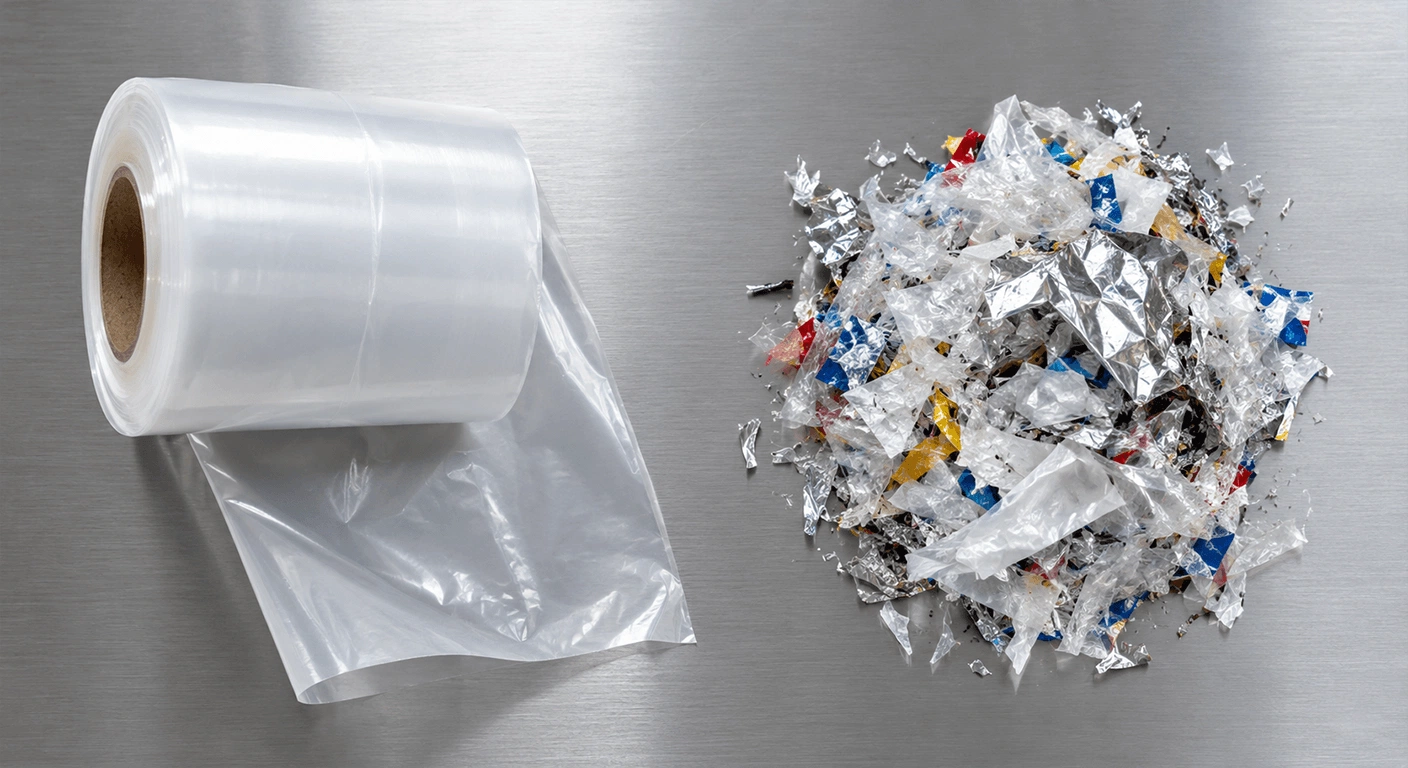
If you have held a pouch printed with a small recycling symbol and felt a flicker of doubt, you are not alone. Recyclable flexible packaging has become one of the most common claims on retail shelves, yet the gap between a printed arrow and a material actually re-entering a recycling stream remains wide. For brand owners, this is not a philosophical question. It determines whether a sustainability claim survives scrutiny from retailers, regulators, and increasingly informed consumers.
The honest answer is that recyclable flexible packaging is technically achievable today, but only under specific conditions. It requires a mono-material structure, a compatible component set, and access to a collection pathway that actually accepts the finished package. When any of these conditions fail, the claim becomes fragile. This guide examines the technical reality behind recyclable flexible packaging, the certification systems that govern the claim, the infrastructure that determines its fate, and the testing protocols that separate a verifiable design from a speculative one.
The Technical Baseline: What Makes Flexible Packaging Recyclable
The recyclability of flexible packaging is governed by one structural principle: material homogeneity. A package made from a single polymer family—almost always polyethylene (PE) or polypropylene (PP)—can be mechanically reprocessed alongside other streams of the same resin. A package made from multiple incompatible polymers cannot.
The distinction is captured in the difference between mono-material multilayer (MoMu) and multi-material multilayer (MuMu) structures. A MoMu structure may still have multiple functional layers—a sealant layer, a barrier layer, a printing layer—but all layers belong to the same polymer family. A MuMu structure, by contrast, combines different polymers (for example, PET, aluminum foil, and PE) to achieve barrier and mechanical performance that no single material can deliver alone.
Quantifying this difference is not a matter of opinion. A 2026 study published in Waste Management introduced a recyclability index (RI) to measure how different laminate architectures perform under closed-loop mechanical recycling. Multi-material laminates containing BOPA or BOPET exhibited severe processing limitations, with RI values of 0.18 to 0.21—an 80% loss relative to virgin material performance. Mono-material PE laminates, by contrast, maintained stable film-blowing processability, with BOPE achieving the highest RI at 0.85.
That gap is the technical foundation of the recyclable flexible packaging claim. A pouch that looks recyclable but contains a PET or aluminum foil layer is not recyclable flexible packaging in any operational sense. It is a MuMu structure destined for incineration or landfill.
The Barrier Problem: Can Mono-Material Match Multi-Material?
The persistent objection to recyclable flexible packaging is that mono-material structures cannot match the barrier performance of foil or metallized laminates. This objection is partly true, but the gap is closing.
Mono-material PE and PP structures can now incorporate thin barrier layers that remain within recyclability thresholds. Aluminum oxide (AlOx) and silicon oxide (SiOx) coatings provide oxygen and moisture barrier without introducing a separate polymer phase. Limited EVOH content can be used, provided it stays below the concentration thresholds set by design-for-recycling guidelines. The result is a MoMu structure that delivers barrier performance approaching foil laminates while remaining compatible with PE or PP recycling streams.
The trade-offs are real. A mono-PE recyclable flexible packaging structure may require a thicker sealant layer to compensate for stiffness loss, and it may not achieve the same shelf-life extension as a foil-based laminate for highly oxygen-sensitive products. But for a growing range of food, personal care, and household applications, the performance is sufficient. The question is no longer whether recyclable flexible packaging can work technically. It is whether the entire system—design, certification, and infrastructure—supports the claim. 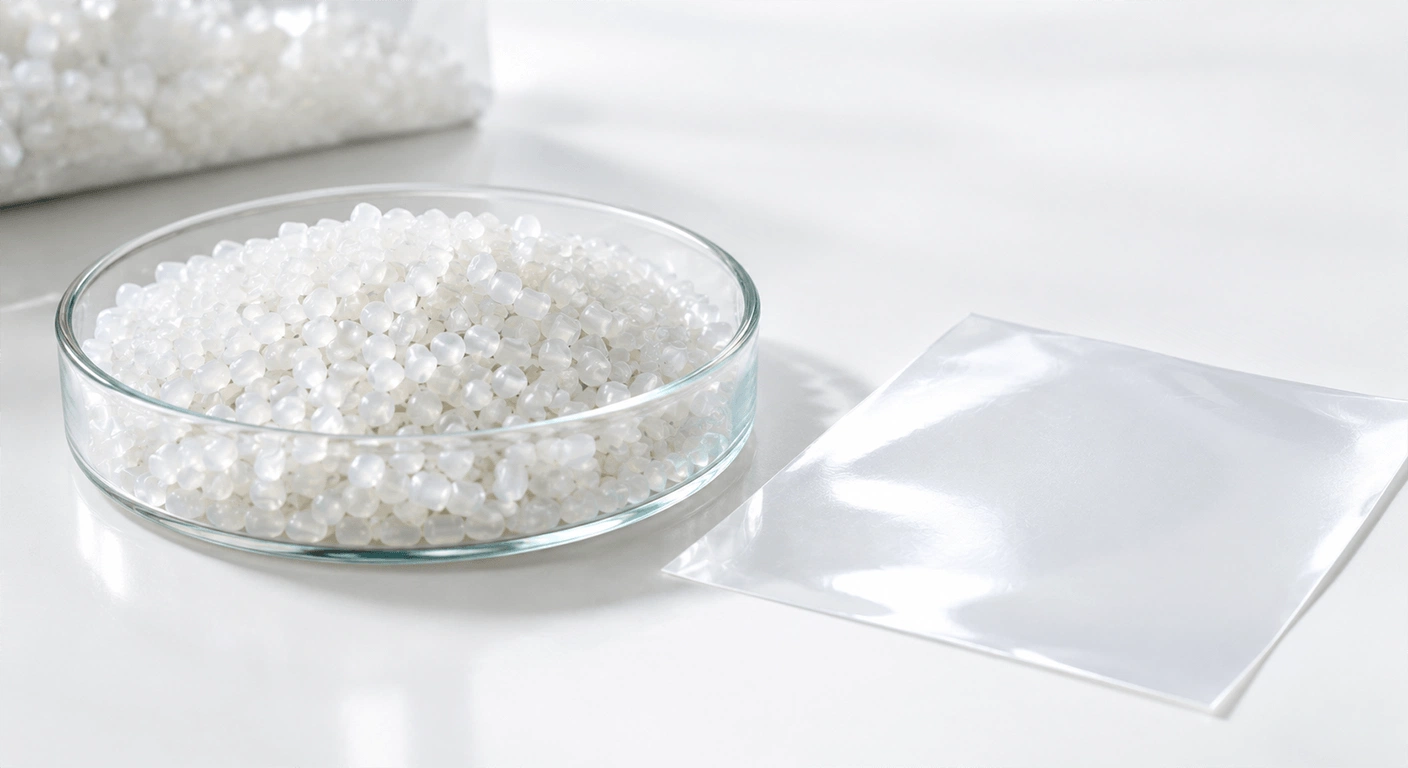
The Certification Reality: What a Recycling Label Actually Means
A recycling symbol on a pouch is not a legal guarantee. It is a claim governed by specific certification frameworks, and those frameworks have strict eligibility rules that many brands overlook.
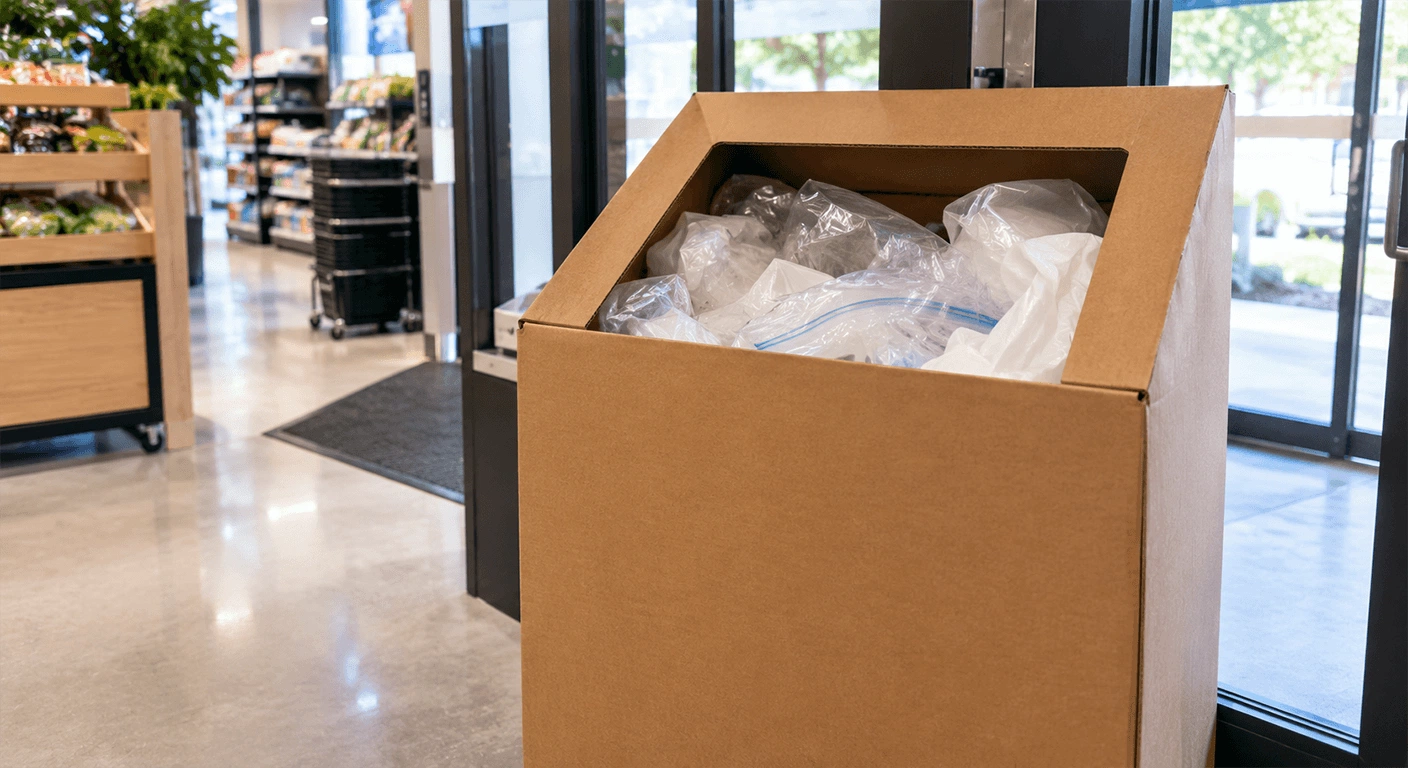
In the United States, the relevant system for recyclable flexible packaging is the How2Recycle Store Drop-off label. This label does not mean the pouch can go into a curbside bin. It means the pouch is accepted at participating retail locations that collect plastic film—the same bins used for grocery bags and stretch wrap. To use the label legitimately, a brand must be a How2Recycle member and submit the complete finished package—film, ink coverage, adhesive, zipper, spout, and label included—for a recyclability review. Approval is tied to that exact configuration; swapping a zipper or adding a barrier coating can require re-submission.
The eligibility rules are narrow. Store Drop-off applies to flexible polyethylene-based plastics, including HDPE (#2) and LDPE (#4). A pouch made from a mono-material PE structure qualifies only if every component—including the zipper and spout—is PE-compatible. A PE pouch with a PET-based zipper is not recyclable flexible packaging under this system, even if the base film is mono-material.
In Europe, the RecyClass Design for Recycling guidelines serve a similar function. These guidelines set material thresholds and component compatibility rules for PE and PP flexible packaging. The March 2026 update, for example, revised guidance on electron-beam treatment for PE flexibles and confirmed the compatibility of certain ink systems, based on new laboratory findings. A recyclable flexible packaging structure that meets RecyClass thresholds is more likely to be accepted by European sorting and recycling operations—but the guidelines are voluntary design tools, not a guarantee of collection.
The certification layer matters because it separates a verifiable claim from an aspirational one. A brand that prints “recyclable” without a How2Recycle or RecyClass assessment is making a claim that may not survive regulatory scrutiny, particularly as the EU Packaging and Packaging Waste Regulation (PPWR) moves toward mandatory recyclability requirements by 2030.
The Infrastructure Gap: Why Design Alone Is Not Enough
Even a technically recyclable, certified recyclable flexible packaging structure can fail at end-of-life if the collection and sorting system does not accept it.
The infrastructure gap is stark. In the United States, the recycling rate for flexible plastic packaging is below 1%, the lowest of any packaging type. Single-stream material recovery facilities (MRFs) treat flexible packaging as a contaminant, and recovery efficiency is estimated on the order of 1%. Store Drop-off programs exist, but they depend on consumer participation and retailer collection infrastructure, and the actual recovery rate through drop-off pathways is uncertain.
Europe performs better in aggregate—41% of plastic packaging was recycled in 2022—but flexible films remain a challenging fraction. Dedicated lightweight packaging streams in the EU can recover film with over 50% efficiency, but not all member states have equivalent sorting infrastructure. The PPWR’s 2030 recyclability mandate is designed to force improvement, but it does not instantly create end markets for recycled film.
This is the uncomfortable truth about recyclable flexible packaging: a design can be recyclable in principle and still be landfilled in practice. The claim is only meaningful when it is paired with a realistic end-of-life pathway. For brands selling in markets without Store Drop-off access or dedicated film collection, a mono-material structure may reduce material complexity but not guarantee recovery.

How Brands Verify the Claim: Testing Beyond the Label
For brand owners, the practical question is how to verify that a recyclable flexible packaging structure performs as claimed. Certification is a starting point, but technical validation is necessary to ensure that recyclability does not come at the cost of package integrity.
Several test protocols are relevant. Oxygen transmission rate (OTR) testing, typically performed per ASTM D3985, confirms whether a mono-material barrier structure still protects the product. Seal strength testing, per ASTM F2029 or ASTM F88, verifies that the sealant layer—often a PE-based film—maintains bond integrity after the transition from a multi-material laminate. Gelbo flex testing (ASTM F392) evaluates flex-crack resistance, which is particularly important for mono-material structures that may have different mechanical behavior than foil laminates.
These tests do not prove recyclability. They prove that the package still functions as packaging after being redesigned for recyclability. A recyclable flexible packaging structure that fails seal integrity or barrier performance is not a sustainable solution; it is a packaging failure with a recycling label.
The Realistic Path Forward
Recyclable flexible packaging is not a myth, but it is not a universal solution either. It is a design pathway that works when three conditions align: a mono-material structure that meets performance requirements, a certification pathway that validates the finished package, and an end-of-life system that actually collects and processes the material.
The industry is moving in that direction. Mono-material PE and PP structures are commercially available, barrier coatings are improving, and design-for-recycling guidelines are becoming more specific. But the infrastructure gap remains the binding constraint. No amount of design innovation can compensate for a collection system that does not exist.
For brands, the responsible approach is to treat recyclable flexible packaging as a verifiable engineering claim, not a marketing label. That means asking suppliers for material composition data, confirming certification eligibility for the finished package, and understanding the collection reality in each market of sale.
How Jili Packaging Supports Recyclable Flexible Packaging Projects
At Jili Packaging, we work with brands to evaluate recyclable flexible packaging structures against both performance requirements and end-of-life realities. Our capabilities include:
-
Mono-material structure design: PE-based and PP-based laminates with barrier coatings (AlOx, SiOx) and EVOH within recyclability thresholds.
-
Component compatibility: PE-compatible zippers, spouts, and valves to maintain a single polymer family across the finished package.
-
Certification support: Documentation for How2Recycle Store Drop-off and RecyClass design-for-recycling assessments.
-
Performance validation: OTR, WVTR, seal strength, and Gelbo flex testing to confirm that recyclability does not compromise package integrity.
-
Regulatory documentation: PPWR compliance support, recycled content verification, and material declarations for target markets.
We do not treat recyclable flexible packaging as a checkbox. We treat it as an engineering problem that requires matching material structure, component selection, and market-specific end-of-life pathways. If you are evaluating a mono-material transition or need to validate a recyclability claim, our team can support the technical work from concept through production.


