

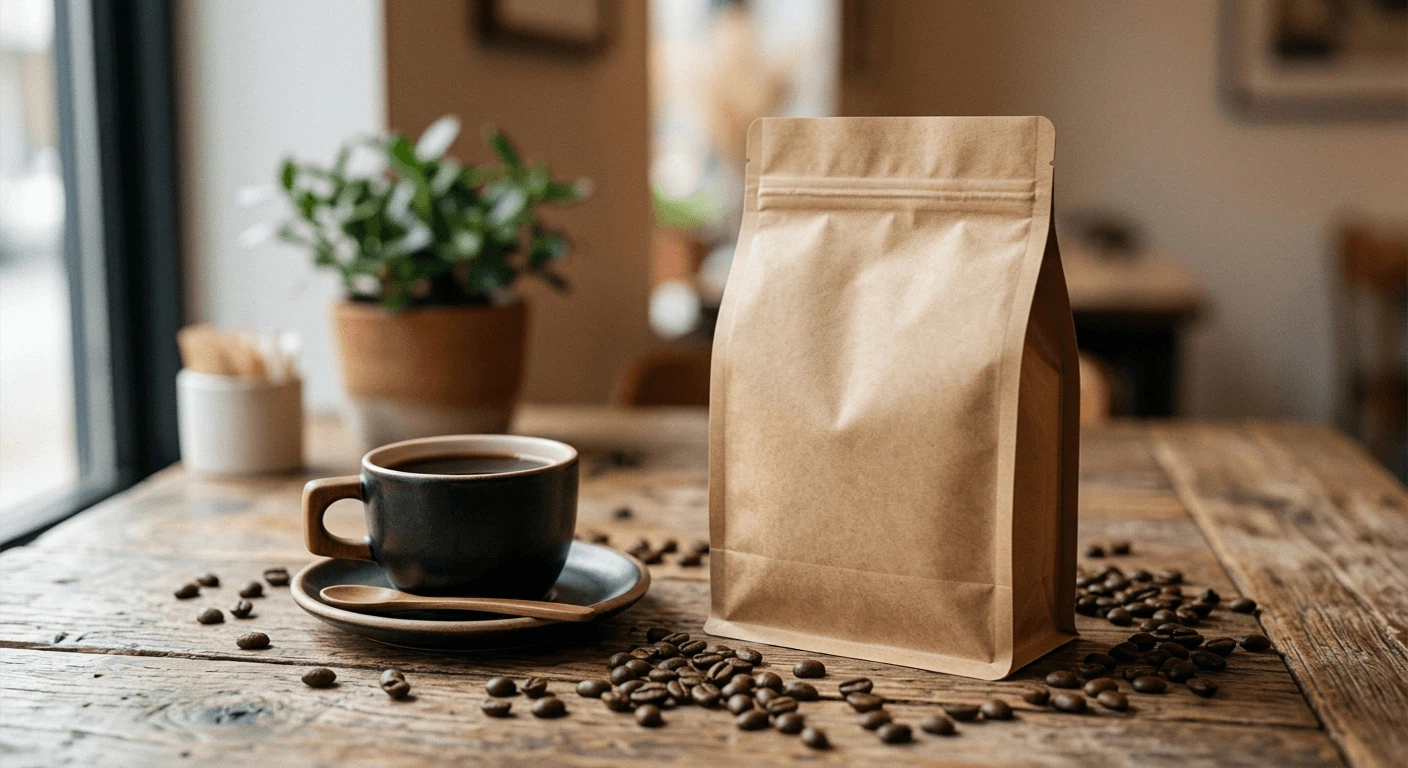
What is a coffee bag? Most people would answer with a simple description: a bag that holds coffee. But for a brand owner, a packaging engineer, or a procurement manager, that answer misses almost everything that matters. A coffee bag is a high-barrier flexible packaging system engineered to protect a living, chemically active product from the moment it leaves the roaster until the consumer opens it. Coffee beans begin releasing carbon dioxide immediately after roasting. At the same time, they are highly vulnerable to oxygen, moisture, heat, and light—the four enemies that turn a bright, aromatic roast into a flat, stale commodity. A properly designed coffee bag manages all of these variables simultaneously. It is not just a container. It is a freshness lock, an oxygen barrier, a pressure management device, and a brand statement, all in one flexible format.
This guide explains what a coffee bag is from a packaging manufacturer’s perspective: the functions it must perform, the material structures that make those functions possible, the valve technology that solves coffee’s unique degassing challenge, the format options available, and the quality standards that separate a high-performance coffee bag from a commodity pouch.
Why Coffee Needs Specialized Packaging
Coffee is one of the most demanding products to package. The reason is simple: roasted coffee is alive. From the moment roasting ends, beans continue to release carbon dioxide trapped inside their cellular structure during the roast. This process, called degassing, can continue for days or even weeks. Darker roasts generally release more CO₂ than lighter roasts, and ground coffee degasses much faster than whole beans because of its larger surface area.
At the same time, coffee’s aromatic oils are highly susceptible to oxidation. Even small amounts of oxygen can turn a bright, fruity roast flat within weeks. Moisture accelerates this degradation, and light exposure breaks down the volatile compounds responsible for aroma. Temperature fluctuations compound the problem, accelerating chemical reactions inside the bag.
A coffee bag must therefore perform five functions simultaneously:
-
Oxygen barrier. Block external oxygen from entering the package.
-
Moisture barrier. Prevent humidity from reaching the beans.
-
Light barrier. Protect aromatic oils from photo-oxidation.
-
Pressure management. Allow CO₂ to escape without letting oxygen in.
-
Seal integrity. Maintain a hermetic seal throughout storage, shipping, and retail display.
No single material can achieve all five. That is why coffee bags are engineered as multi-layer structures.
The Material Structure of a Coffee Bag
A typical high-barrier coffee bag is a laminated structure combining multiple materials, each contributing a specific function. The most common configuration is a three-layer laminate: PET (polyester) as the outer layer, aluminum foil or metallized film as the middle barrier layer, and PE (polyethylene) or CPP as the inner sealing layer.
Outer layer: PET or BOPP. The outermost layer provides mechanical strength, print quality, and scuff resistance. PET is widely used for premium coffee bags because it accepts high-resolution printing and offers good dimensional stability. BOPP (biaxially oriented polypropylene) is an alternative that supports mono-material recyclable structures.
Middle layer: aluminum foil, metallized film, or high-barrier film. This is the barrier layer. Aluminum foil, typically 7–9 microns thick, provides an almost absolute barrier against oxygen, moisture, and light. Metallized PET (VMPET) offers a good compromise: strong barrier performance at lower cost and lighter weight. Emerging alternatives include EVOH-based films and high-barrier PP films that eliminate aluminum while maintaining oxygen and moisture protection.
Inner layer: PE or CPP. The innermost layer contacts the coffee directly. It must be food-grade, heat-sealable, and chemically inert. PE is the most common choice. CPP (cast polypropylene) is used when higher temperature resistance or better seal strength is required.
The choice of structure depends on the required shelf life, the distribution environment, and the brand’s sustainability commitments. A standard PET/AL/PE laminate offers excellent barrier performance but is difficult to recycle. A mono-material PP structure with high-barrier coating offers recyclability at some trade-off in barrier performance.
The One-Way Degassing Valve: Coffee’s Essential Component
The one-way degassing valve is what separates a coffee bag from an ordinary flexible pouch. It is a small multi-part fitting, usually heat-sealed onto the bag surface, that allows carbon dioxide to escape while preventing oxygen from entering.
The valve works through a pressure differential mechanism. When internal pressure from CO₂ buildup exceeds the force holding the valve membrane closed, the membrane lifts and gas escapes. When internal pressure drops, the membrane reseats, sealing the package against outside air. Think of it as a one-way turnstile: gas can leave, but nothing enters through the same path.
Without a degassing valve, a sealed coffee bag would inflate like a balloon as CO₂ accumulates. The pressure can rupture seams, distort the package shape, and compromise seal integrity. A swollen or burst bag is not acceptable for retail.
Valve types. Coffee bag valves fall into several categories based on placement and construction:
-
External (surface) valves sit on the outside of the bag film. They are the most common type and are easy to apply during bag conversion.
-
Internal valves are positioned inside the bag, protecting the valve mechanism from external damage during shipping and handling.
-
Label-style valves use a pressure-sensitive adhesive label that vents gas through a small opening. These are increasingly popular because they streamline production and can be applied further downstream without compromising quality.
-
Recyclable and compostable valves are emerging to match mono-material and compostable bag structures. Conventional valves are typically made from PE and PP components, which can interfere with recycling if the bag is otherwise mono-material.
Valve material matters for sustainability. A mono-material recyclable bag with a conventional plastic valve may not pass recyclability validation. Recyclable valve designs that match the bag’s polymer are essential for brands pursuing circular packaging claims.
Coffee Bag Formats: Matching Structure to Product and Channel
Coffee bags come in several structural formats, each optimized for different fill weights, shelf presentation requirements, and distribution channels.
Flat Bottom Bags
Flat bottom bags, also called box-bottom or quad-seal pouches, have a rigid rectangular base and clean vertical side seams. They stand upright without support, almost like a small box. This format offers five printable panels, giving brands generous space for branding, origin stories, and certifications. The square base holds more volume in a compact footprint, making it ideal for 250g to 1kg fills.
Flat bottom bags are the preferred format for specialty roasters selling through retail shelves, coffee shops, and boutique grocers. The trade-off is higher production cost due to the more complex structure, and the format requires a certain fill volume to look its best. A half-empty flat bottom bag loses its crisp shape and premium feel.
Side Gusset Bags
Side gusset bags are the classic coffee packaging format. They use side folds to expand the bag, creating a taller, narrower profile. Side gusset bags are generally more economical to produce than flat bottom bags because the manufacturing process is simpler. They are highly cost-effective for bulk items and run efficiently on fill lines.
The limitation is shelf presentation. Side gusset bags typically do not stand on their own as reliably as flat bottom bags, especially as product is consumed. They also offer less printable front-face area. For brands prioritizing cost efficiency and shipping volume over premium shelf presence, side gusset bags remain a practical choice.
Stand-Up Pouches
Stand-up pouches have a gusset at the base that unfolds to create a stable bottom when filled. They are lighter than flat bottom bags, cheaper to ship, and highly customizable. For direct-to-consumer brands, the flat, lightweight profile reduces shipping weight and slips easily into mailers. Stand-up pouches handle a wide fill range, from single-serve samples to 500g bags, without looking awkward. Adding a resealable zipper makes the format convenient for home use.
Specialty Formats
Beyond the three main formats, coffee packaging includes stickpacks and sachets for single-serve applications, brick packs for compact retail display, fractional packs for foodservice portion control, and bulk pillow packs produced on VFFS equipment for in-store grinding operations. Each format is engineered for a specific use case, and the choice depends on fill weight, distribution channel, and consumer usage occasion.
Zipper and Reclose Systems
Resealability has become a baseline expectation for retail coffee bags. A zipper allows consumers to reseal the bag after opening, slowing the rate of staling between uses. Common zipper types include press-to-close (flange zipper) and slider zippers. For premium applications, lock or peelable sealants can be incorporated to provide a tamper-evident seal that the consumer peels open before accessing the zipper.
The zipper must be compatible with the bag’s material structure. On a mono-material recyclable bag, the zipper should be made from the same polymer family to avoid contaminating the recycling stream.
Sustainability in Coffee Bag Packaging
Sustainability has shifted from a differentiator to a baseline expectation in coffee packaging. Consumers increasingly align with brands that demonstrate environmental responsibility through packaging choices, not just sourcing claims.
The traditional PET/AL/PE coffee bag structure is difficult to recycle because the layers cannot be easily separated. The industry is responding with several approaches:
Mono-material PP structures. Fully recyclable PP-based coffee bags with high-barrier films can now match the oxygen and moisture protection of traditional foil laminates. These structures are designed for existing PP recycling streams, making them compatible with store drop-off programs.
Aluminum-free high-barrier films. Metallized films and EVOH-based barrier layers can replace aluminum foil while maintaining adequate barrier performance for many coffee applications. This reduces material complexity and improves recyclability.
Store drop-off recyclable bags with valves. New valve designs specifically engineered for recyclable bag structures allow brands to offer a recyclable coffee bag without sacrificing freshness protection. These bags can carry store drop-off recycling labels and are third-party tested for compatibility with recycling guidelines.
The trade-off is real. Mono-material structures may have slightly lower barrier performance than foil laminates, which can affect shelf life. Brands must validate that the recyclable structure meets their specific shelf-life requirements before committing to a full production run.
Quality Validation: How Coffee Bags Are Tested
A coffee bag that performs in the lab but fails in the supply chain is a liability. Quality validation for coffee bags covers several dimensions:
Barrier testing. Oxygen transmission rate (OTR) and water vapor transmission rate (WVTR) tests measure the barrier performance of the laminate. These values determine the theoretical shelf life of the packaged coffee.
Seal strength testing. Seal integrity is critical for both freshness and package durability. Tests include peel strength, burst pressure, and leak detection. A weak seal can allow oxygen ingress or fail during shipping.
Valve function testing. The degassing valve must open at the correct pressure threshold and reseal reliably. Valve testing ensures that CO₂ can escape without allowing oxygen back in.
Drop and compression testing. Filled coffee bags must survive handling and stacking during distribution. Drop tests and compression tests simulate real-world conditions to identify structural weaknesses.
Accelerated shelf-life testing. By storing packaged coffee at elevated temperatures and measuring oxidative markers over time, brands can estimate real-world shelf life without waiting months for results. Studies have shown that storage temperature significantly affects the rate of quality deterioration in packaged coffee.
How to Choose a Coffee Bag Supplier
Selecting a coffee bag manufacturer involves more than comparing unit prices. Key evaluation criteria include:
Material capability. Can the supplier offer the full range of structures—foil laminates, metallized films, and mono-material recyclable options? Can they recommend the right barrier level for your specific shelf-life target?
Valve integration. Does the supplier have experience with valve placement, valve types, and valve compatibility with different bag structures? Valve application requires precise heat-sealing and positioning to maintain seal integrity.
Print quality. Coffee bags are brand-critical packaging. High-resolution printing, accurate color reproduction, and consistent registration across runs are essential. Ask for printed samples, not just digital proofs.
Certifications. Food-contact compliance is non-negotiable. Look for ISO 22000, BRCGS, or SQF certification for food safety management. FSC certification for paper components and GRS certification for recycled content are increasingly required by brands with sustainability commitments.
Recyclability validation. If you are pursuing a recyclable coffee bag, ask the supplier for third-party validation of recyclability, not just a claim. Test reports from organizations like the Association of Plastic Recyclers provide credible evidence.
How Jili Packaging Supports Coffee Bag Projects
At Jili Packaging, we supply coffee bag solutions for roasters, brands, and private-label operators across retail and foodservice channels. Our capabilities include:
-
Material structures: PET/AL/PE, PET/VMPET/PE, mono-material PP recyclable structures, and high-barrier aluminum-free laminates.
-
Valve integration: one-way degassing valves in external and label-style configurations, with recyclable valve options for mono-material bags.
-
Bag formats: flat bottom bags, side gusset bags, stand-up pouches, stickpacks, and rollstock film for VFFS operations.
-
Printing: 10-color high-precision printing with HD flexo and extended gamut capabilities for premium graphics.
-
Reclose systems: press-to-close zippers, slider zippers, and peelable sealants.
-
Quality documentation: OTR/WVTR test reports, seal strength data, valve function validation, and migration testing for food-contact compliance.
-
Sustainability support: mono-material structure development, recyclability validation, and recycled content integration.
We work with coffee brands at every stage, from first prototype through commercial production. Whether you are launching a new single-origin line, switching to a recyclable structure, or scaling a private-label program, we can match the material, format, and valve configuration to your product and market requirements.
Contact Jili Packaging to discuss your coffee bag requirements and request samples.


