
What are the common printing technologies for flexible packaging? If you are a brand owner about to approve a packaging design, this question will determine how your product looks on the shelf, how much you pay per unit, and how quickly you can get to market. Flexible packaging printing is not a single process. It is a family of technologies, each with its own economics, quality ceiling, and ideal production window. Choosing the wrong one can mean paying for cylinders you will never amortize, or accepting print quality that undersells your brand.
This guide explains the common printing technologies for flexible packaging—flexography, rotogravure, and digital printing—along with the critical distinctions of surface printing versus reverse printing and the ink systems that determine food safety and recyclability. It is written for brands and procurement teams who need to match printing technology to product, volume, and market.
Why Printing Technology Matters More Than You Think
Flexible packaging printing determines three things that directly affect your business:
-
Shelf impact. Color accuracy, registration, and finish quality decide whether your package gets noticed in a crowded aisle.
-
Unit cost. The same design can cost dramatically different amounts per pouch depending on whether you use engraved cylinders or photopolymer plates.
-
Time to market. Cylinder engraving adds weeks to a launch timeline. Digital printing can compress that to days.
The common printing technologies for flexible packaging fall into two broad categories: conventional analog printing (flexography and rotogravure) and digital printing (inkjet and electrophotography). A third category—hybrid printing—combines both on a single press. Each has a distinct production window where it is the rational choice.
Flexographic Printing: The Workhorse of Flexible Packaging
Flexographic printing, or flexo, is the most widely used printing technology for flexible packaging. It uses a flexible photopolymer plate mounted on a plate cylinder to transfer ink onto the substrate. The plate carries a raised image; ink is metered by an anilox roller and transferred directly to the film.
How Flexo Works
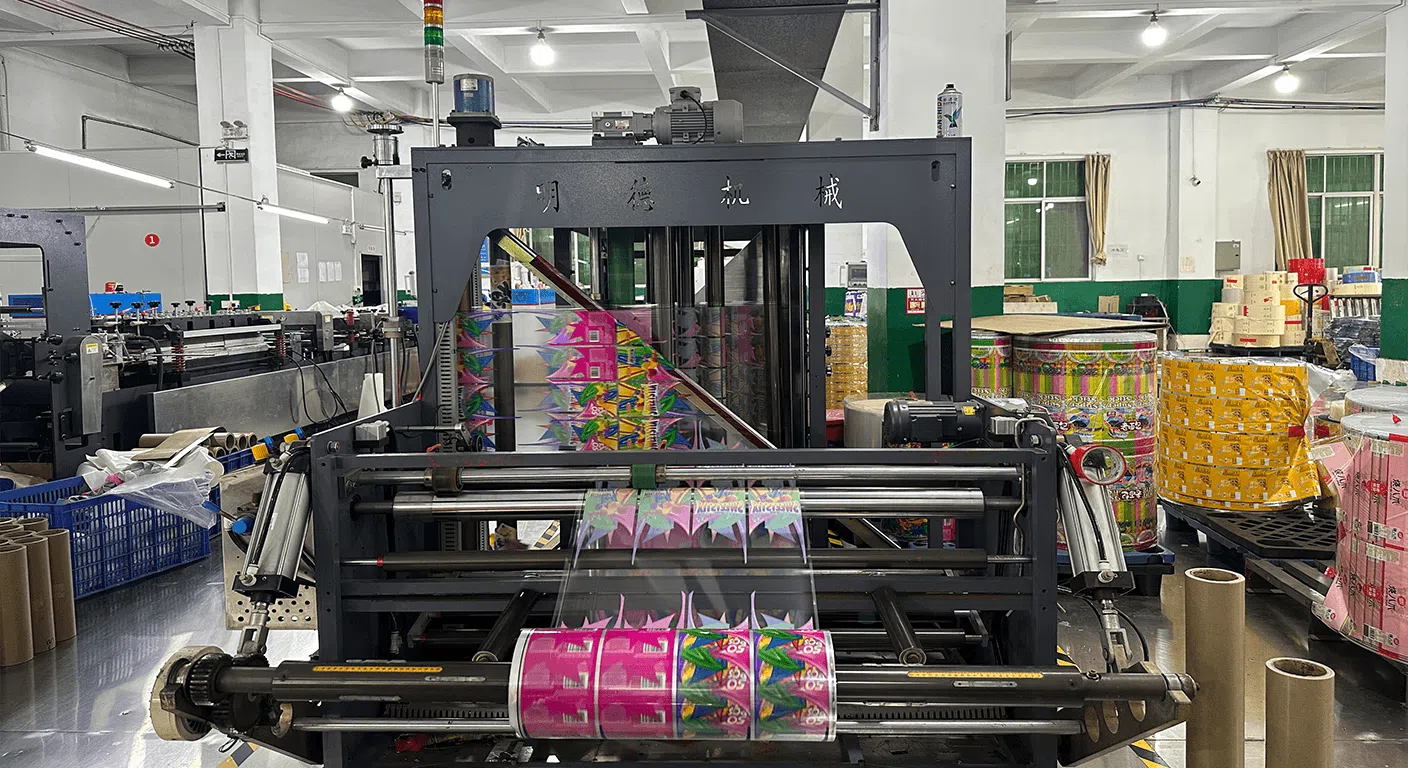
A flexo press consists of multiple stations, each printing one color. The substrate passes through each station, where a plate cylinder, anilox roller, and ink supply work together to apply a single color. Drying or curing occurs between stations. A typical CI (central impression) flexo press for flexible packaging runs 8 to 10 colors and can reach speeds of up to 600 meters per minute.
Advantages of Flexo
-
Lower plate costs. Flexo plates cost significantly less than gravure cylinders, making flexo accessible for medium-volume runs and frequent design changes. Plates can be swapped out easily when a design needs updating.
-
Substrate versatility. Flexo prints well on a wide range of films, including thinner and recyclable materials. It is particularly well suited to mono-material structures where gravure may struggle with tension control.
-
Sustainability position. Flexo is further along on sustainability than gravure. Water-based inks and non-solvent plate processing are more advanced, and the shift away from solvent-based systems is well underway.
-
Speed. Modern flexo presses run at high speeds, and make-ready times have been reduced through automation and zero-make-ready technology.
Limitations of Flexo
-
Quality ceiling. Traditional flexo has historically lagged behind gravure in fine detail and smooth gradients. However, HD flexo technology has closed much of that gap. Today, HD flexo can reach qualities equal or similar to gravure technology.
-
Setup time. Flexo setup involves plate mounting, registration, and color matching. While faster than gravure cylinder preparation, it still requires careful make-ready.
When to Choose Flexo
Flexo is the right choice for medium to long runs where plate costs can be spread across sufficient volume. It is also ideal for brands transitioning to recyclable mono-material structures, because flexo handles thinner films more reliably than gravure. For food packaging where low-migration inks are required, flexo with water-based or UV-curable low-migration systems is a mature solution.
Rotogravure Printing: Premium Quality at Scale
Rotogravure, or gravure, is an intaglio printing process. The image is engraved into a copper cylinder, which is then chromium-plated for durability. The cylinder rotates in an ink bath; a doctor blade removes excess ink from the non-image areas, and the ink remaining in the engraved cells is transferred to the substrate.
How Gravure Works
Each color requires its own engraved cylinder. Cylinder preparation involves electroplating, engraving, and chromium plating—a complex and costly process that typically takes weeks. Once the cylinders are made, gravure presses run at very high speeds, up to 1,000 meters per minute.
Advantages of Gravure
-
Superior print quality. Gravure delivers exceptional image reproduction, sharp graphics, and highly consistent colors over very long runs. It is the standard against which all other flexible packaging printing is measured for premium appearance.
-
Lowest unit cost at very high volumes. Once cylinder costs are amortized, gravure offers the lowest running cost per unit. The higher initial investment pays back on large production runs.
-
Extended color gamut. Modern gravure presses can use oneECG (Extended Color Gamut) systems with a fixed set of seven inks (CMYK plus Orange, Green, Violet), enabling a wider range of Pantone colors without changing cylinders or inks between jobs.
Limitations of Gravure
-
High cylinder cost. Engraved cylinders cost significantly more than flexo plates. Plate fees for gravure can run $300–$500+ per color, with 4–6 week lead times.
-
Poor agility. Design changes require new cylinders. Frequent artwork edits or versioned packaging are impractical and expensive.
-
Sustainability challenges. Gravure has historically relied on solvent-based inks. While water-based systems are emerging, the installed base remains dominated by older solvent-ink presses. The use of hexavalent chromium in cylinder production is also under increasing regulatory scrutiny.
-
Tension control on thin films. Gravure can struggle with tension control on very thin, flexible, or shrinkable films, which limits its compatibility with some recyclable mono-material structures.
When to Choose Gravure
Gravure is the rational choice for very long runs where cylinder costs can be amortized, and where premium print quality is a brand requirement. It remains dominant in premium food, beverage, and personal care packaging where photographic-quality imagery, metallic effects, and precise color reproduction are critical. Avoid gravure for short runs, frequent design changes, or pilot launches.
Digital Printing: Speed and Flexibility for the Modern Brand
Digital printing for flexible packaging uses inkjet or electrophotographic technology to apply ink directly to the substrate without plates or cylinders. This eliminates the setup costs and lead times associated with conventional printing.
How Digital Printing Works
Digital presses receive a digital file and print it directly. No plates, no cylinders, no engraving. The press can switch between designs instantly, enabling versioning, personalization, and variable data. HP Indigo digital presses, for example, are widely used in flexible packaging for short-run and on-demand production.
Advantages of Digital Printing
-
No setup cost. Digital printing eliminates plate and cylinder costs entirely, making it economically viable for very short runs—from hundreds to a few thousand units.
-
Fast turnaround. Jobs can be printed in days rather than weeks. This is transformative for new brand launches, market tests, and limited editions.
-
Versioning and personalization. Digital printing enables multiple SKUs, regional variations, and even personalized packaging in a single run without additional setup.
-
Color consistency. Digital printing offers high color consistency compared to traditional methods, and registration can compete with high-quality rotogravure and HD flexo.
Limitations of Digital Printing
-
Higher ink cost. Digital inks are considerably more expensive than conventional flexo or gravure inks. At higher volumes, this cost disadvantage grows.
-
Limited speed. Digital presses are slower than flexo or gravure presses. They are not designed for high-volume production.
-
Substrate compatibility. Not all digital presses can handle the full range of flexible packaging films. Substrate selection may be more limited than with flexo or gravure.
When to Choose Digital Printing
Digital is the right choice for short runs, frequent design changes, personalized packaging, and market tests. It is also valuable for brands launching new products who want to test packaging designs before committing to expensive cylinders or plates. For established brands with stable, high-volume designs, digital is rarely the most cost-effective option.
Surface Printing vs. Reverse Printing: The Invisible Decision
Before choosing a printing technology, you must decide between surface printing and reverse printing. This decision affects durability, food safety, and visual quality.
What Is Reverse Printing?
Reverse printing is the process of printing a mirror-image design onto the inner surface of a transparent film, then laminating that film to an inner layer. The ink ends up sealed between the layers, visible from the outside through the clear outer film. Think of it as a photograph behind glass: the transparent outer film is the glass, the ink is the photograph, and the inner laminate is the backing board.
Surface Printing vs. Reverse Printing: A Comparison
| Dimension | Surface Printing | Reverse Printing |
|---|---|---|
| Ink position | On the outer surface of the film | Sealed between transparent outer film and inner laminate |
| Durability | Vulnerable to scratching, scuffing, moisture fading | Fully protected—no external contact with ink |
| Food safety | Requires additional barrier layer for food-grade compliance | Ink never contacts product—inherent safety advantage |
| Visual quality | Good; requires varnish for gloss | Superior depth and gloss from transparent outer film acting as built-in lacquer |
| Layer structure | Often needs 4-layer minimum | Can achieve simple 3-layer structure (e.g., PET/Alu/PE) |
| Cost profile | Lower upfront; higher per-unit for premium finish | Higher setup; lower incremental cost at scale |
Source: Kete Group reverse printing guide
When to Use Each
Reverse printing is the dominant method for flexible food packaging and premium applications. It protects the ink from abrasion, moisture, and product contact—a non-negotiable requirement for food-grade packaging sold into regulated markets. It also delivers superior visual depth and gloss.
Surface printing is used for applications where durability and food contact are less critical, or where the package structure does not require an inner laminate. It has a lower upfront cost and is compatible with mono-material structures designed for recyclability, because it avoids the need for a separate inner film layer.
Ink Systems: The Hidden Variable in Food Safety and Recyclability
The printing technology you choose determines which ink systems are available to you. Ink choice affects food safety, VOC emissions, and recyclability.
Solvent-Based Inks
Solvent-based inks are the traditional workhorses for flexible film printing. They offer deep color, fast drying, and excellent adhesion to film substrates. They are particularly suited to food packaging where heat and fat resistance are required. However, solvent-based inks emit VOCs and require afterburners or oxidizers to control emissions. They are under increasing regulatory pressure, particularly in Europe.
Water-Based Inks
Water-based inks are the fastest-growing alternative. They reduce VOC emissions and are compatible with flexo and gravure processes. Flexo has moved further than gravure in water-based adoption, with water-wash plate processing replacing solvent-based systems. Water-based inks do have limitations: they can be slower to dry than solvent-based systems, and achieving the same depth of color may require more careful formulation.
UV and LED-Curable Inks
UV and LED-curable inks are 100% solids—no water or solvent carrier that must be evaporated. They cure instantly when exposed to ultraviolet light, enabling high-speed production with no VOC emissions. LED curing eliminates exhaust requirements altogether. However, UV inks have historically been used more in narrow-web label production than wide-web flexible packaging, although advances in LED curing and nitrogen inerting are expanding their adoption.
Low-Migration Inks
For food packaging, low-migration inks are essential. These inks are formulated to minimize the transfer of ink components through the packaging into the food product. Low-migration UV inks dominated the market in 2025 with a 42.3% revenue share, driven by increasing adoption in flexible packaging and food label printing. When specifying food packaging, low-migration certification is a non-negotiable requirement.
Hybrid Printing: The Best of Both Worlds
Hybrid printing combines conventional flexo stations with digital inkjet units on a single press. This allows a single production line to handle both high-volume flexo work and short-run digital jobs without changing equipment.
Hybrid presses are becoming standard in labels and are growing in flexible packaging. They enable converters to offer short-run specialty jobs and high-volume production on the same platform, with superior print quality and faster turnaround times. For brands that need both versioned short runs and stable high-volume SKUs, hybrid printing can eliminate the need to split production across multiple suppliers.
Decision Framework: Matching Printing Technology to Your Project
Use this checklist to guide your printing technology decision:
-
What is your annual volume? Under 5,000 units: digital. 5,000–50,000 units: flexo (or digital if design changes frequently). 50,000–200,000 units: flexo. Over 200,000 units: evaluate gravure vs. flexo based on quality requirements.
-
How often will the design change? Frequent changes favor digital or flexo. Stable designs favor gravure at high volume.
-
What print quality does your brand require? Premium photographic imagery, metallics, and precise color: gravure or HD flexo. Standard retail graphics: flexo. Prototypes and market tests: digital.
-
Is the package for food contact? Yes: require low-migration inks and consider reverse printing. No: surface printing may be acceptable.
-
Does the package need to be recyclable? Yes: evaluate mono-material structures with surface printing and water-based or UV inks. Reverse printing with multi-layer laminates is more difficult to recycle.
-
What is your timeline? Cylinder engraving adds 4–6 weeks. Flexo plate production adds days. Digital printing adds hours.
How Jili Packaging Supports Your Printing Requirements
At Jili Packaging, we work with brands across food, beverage, pet food, and liquid packaging applications to match printing technology to product requirements. Our capabilities include:
-
10-color high-precision printing for flexo and gravure applications, with HD flexo and extended gamut capabilities for premium graphics.
-
Digital printing for short runs, prototypes, and versioned packaging.
-
Low-migration ink systems for food-contact packaging, with documented migration testing.
-
Surface and reverse printing structures, including mono-material recyclable options.
-
Print quality validation including registration control, color consistency testing, and seal integrity verification.
We do not push a single printing technology. We help you choose the right one based on your volume, design stability, quality requirements, and regulatory needs—then we deliver it. If you are evaluating printing technologies for your next flexible packaging project, contact Jili Packaging to discuss your requirements and request samples.


